AI in agribusiness: article by F&S CAP's Leonardo de La Vega featured on Agrimídia
An article by Leonardo Thielo de La Vega, CEO of F&S CAP, in Suinocultura Industrial magazine shows how AI, computer vision and sensors are transforming animal welfare and disease prediction, and where a software house for agribusiness fits in.
Issue no. 03/2026 of Suinocultura Industrial, one of the most traditional publications of the Brazilian animal production industry, dedicated to swine farming, features in its Technology section the article "AI's contribution to animal welfare practices and disease prediction", by Leonardo Thielo de La Vega, veterinarian, researcher and CEO of F&S CAP, a strategic partner of Espresso Labs in agribusiness.
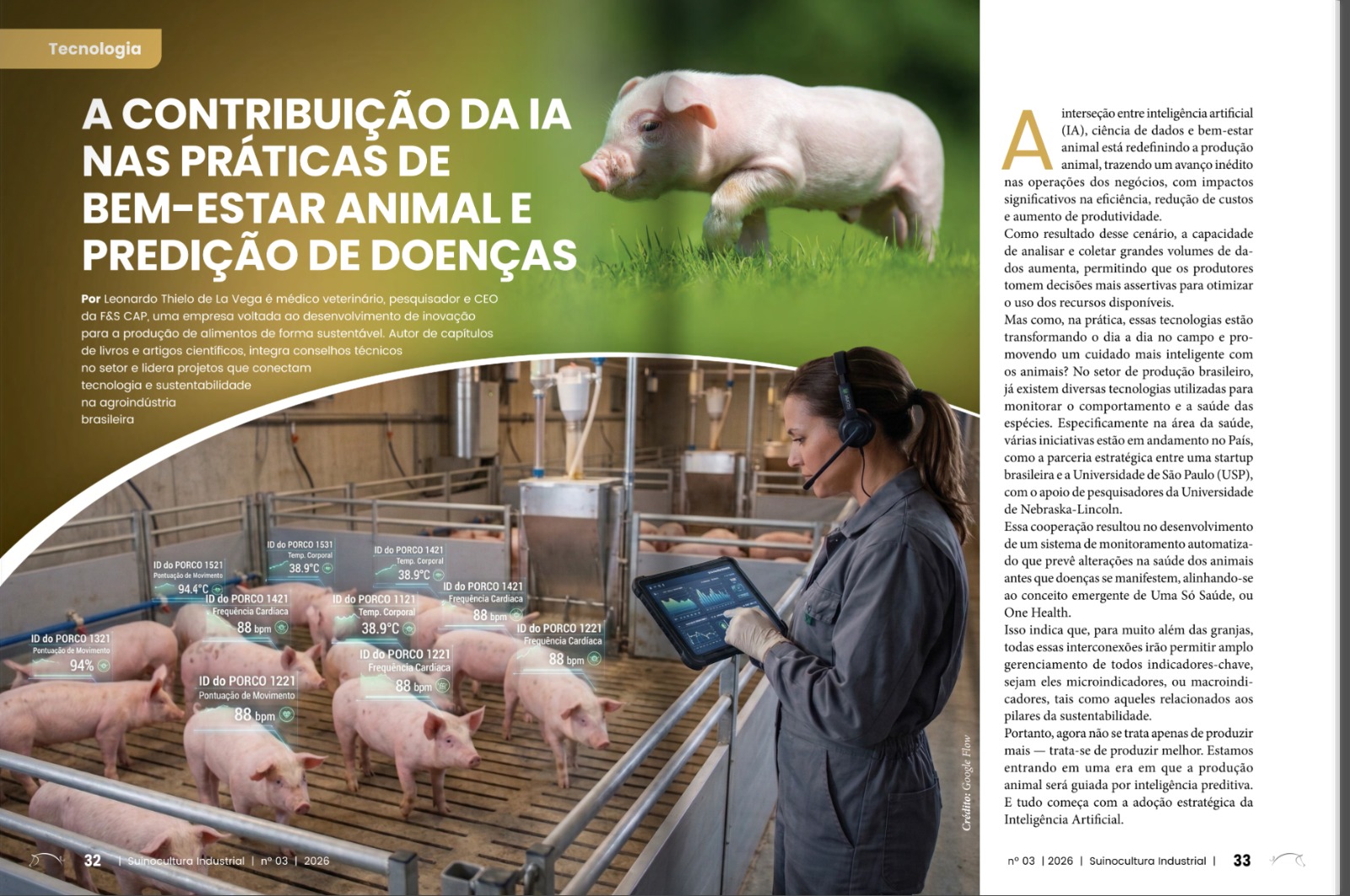
The piece is a panorama of how the intersection of AI, data science and animal welfare is redefining production, and the points that speak most directly to software technology are worth summarizing.
From the herd to the individual animal
The turning point described in the article is the shift from collective to individualized, continuous monitoring. 2D and 3D cameras and thermal sensors feed algorithms that correlate each animal's body temperature, movement patterns and vocalization with health indicators, making it possible to spot early signs of infectious disease and heat stress before symptoms appear.
The precision is striking: studies cited in the article show computer vision estimating weight from images with 0.99 accuracy, and AI techniques distinguishing patterns of stress, pain and discomfort in the animals' vocalizations and even facial expressions.
Predictive diagnosis on the same track as human medicine
One of the article's highlights is the comparison with medicine: the algorithms applied to animal production share the same technological foundation as the most advanced predictive diagnostic tools used for humans, detecting subtle patterns that precede illness. The practical outcomes range from automated reports for producers and veterinarians to fine adjustments in nutrition and environment, with a drastic reduction in the preventive use of antibiotics, a topic where the article echoes the WHO's warning on antimicrobial resistance.
The text also connects everything to the One Health concept, the integrated approach to human, animal and environmental health, and is honest about Brazil's challenges: poor connectivity in rural areas and a shortage of qualified professionals for this new scenario.
Where a software house for agribusiness fits in
Behind every technology mentioned in the article, sensors, computer vision, neural networks, automated reports, there is a layer that rarely makes headlines: the software that integrates, processes and turns that data into decisions. IoT, cloud computing and AI-based systems, the three pillars the article itself points to as readily applicable on farms, are, in the end, software engineering projects adapted to an environment where the variables are biological and change every cycle.
That is the role of a software house for agribusiness: building and maintaining the custom systems that connect sensors, cloud and AI models to the real routine of farms and processing plants, and keeping them evolving as herds, climate and management change. That is the layer where Espresso Labs operates, in partnership with F&S CAP, which, beyond being a strategic partner, is an investor in Espresso. The combination is what the sector demands: people who understand animal production defining what to measure and why, and people who understand engineering building systems that withstand the reality of the field and evolve with it.
Read the full article in Suinocultura Industrial no. 03/2026 (in Portuguese) and, if your agribusiness is structuring its data and AI journey, bring us the challenge.
Have a similar idea?
Send us a message, we will help you find the best way to bring it to reality