AI in tech design: what changes for designers?
Artificial intelligence has already changed the routine of anyone working in tech design. For UX/UI, Product Design, Graphic Design and other specialties, the transformation is not only in the creation tools, but in the level of responsibility, judgment and strategic participation expected from the professional.
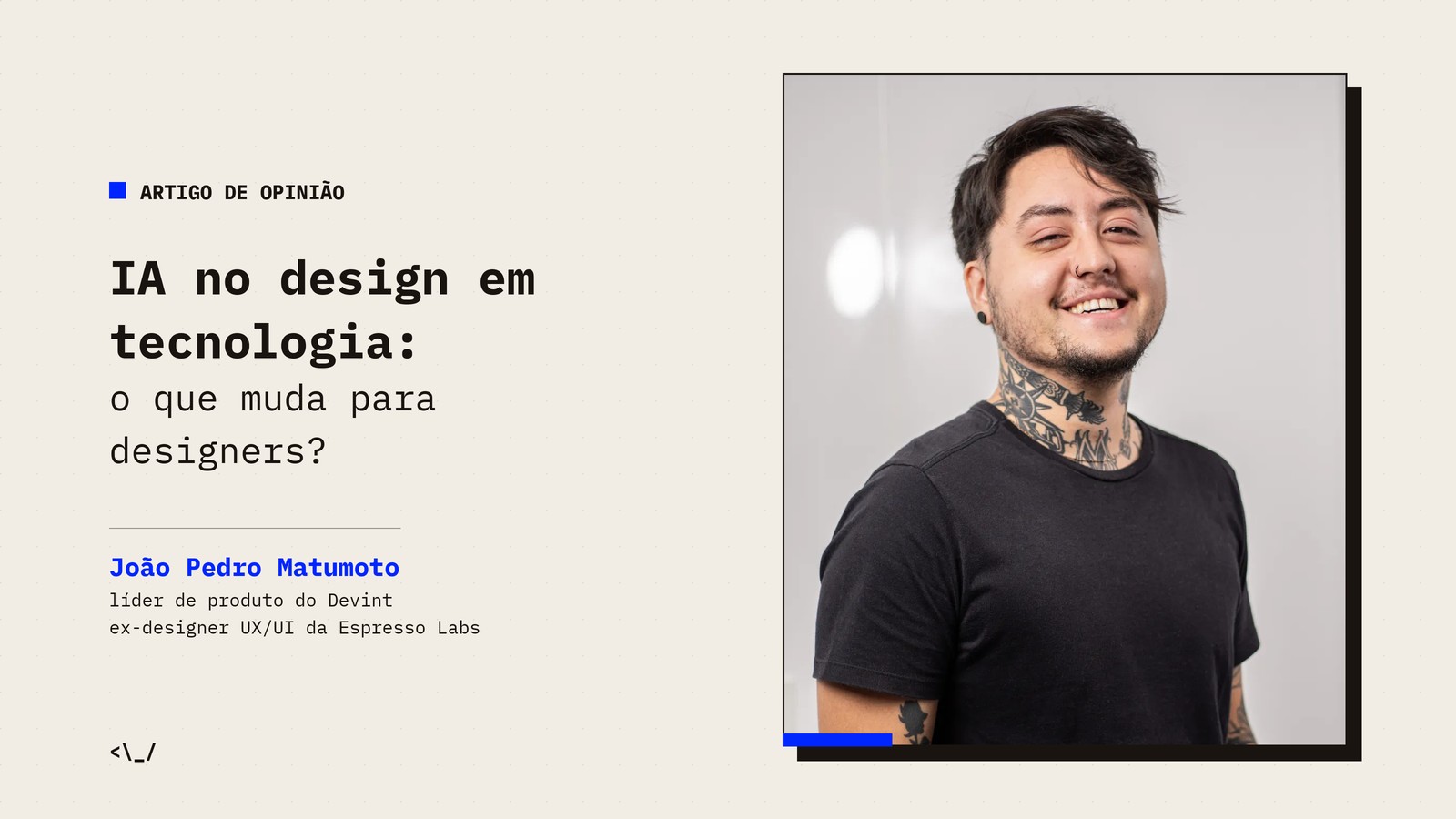
An opinion piece by João Pedro Matumoto, product lead of Devint and, for many years, UX/UI designer at Espresso Labs.
Artificial intelligence has stopped being a distant promise and become part of the routine of anyone working in technology. In tech design, UX/UI design and other design specialties and other areas connected to building digital products, it now takes part in stages that once depended exclusively on the designer's manual work.
Today, a designer can use AI to research, organize information, generate alternatives, analyze interfaces, review copy, create prototypes, explore visual directions, document decisions and speed up repetitive tasks. In some workflows, AI tools can also execute sequences of actions with little human intervention.
That changes an important question: if artificial intelligence can do an ever larger share of the operational work, what becomes the role of a designer working in technology? And what should companies expect from a UX/UI professional in a market where producing became faster?
AI can already do much of the work that used to fill the designer's time
The simplest answer is that a designer today can do more, in less time. AI can support practically the entire design cycle, from the initial organization of information to the exploration of solutions.
In product discovery, for example, it can help synthesize interviews, organize hypotheses, identify patterns in large volumes of information, structure research questions and turn scattered data into material that is easier to analyze. In UX design, it can suggest flows, map usage scenarios, generate information architecture alternatives and point out possible usability problems.
In the interface, the change is even more visible. AI tools can already generate visual references, images, component variations, layouts and even functional prototypes from descriptions. Designers can also use AI to review interface copy, adapt content to different contexts, check consistency and speed up design system documentation.
This does not mean all of those tasks can be delivered directly by AI. It means the cost of producing a first version dropped. The designer can reach a hypothesis faster, test more possibilities and dedicate more time to what requires judgment.
The new differentiator is not just knowing how to execute
For a long time, an important part of a design professional's value lay in the ability to execute. Knowing the tools, mastering processes and producing interfaces with technical quality were clear differentiators.
That knowledge remains fundamental, but artificial intelligence is shrinking the distance between those who hold a certain technical skill and those who can access it through a tool. A person may not fully master a technique and still get a reasonable result with the help of AI.
That is why behavioral competencies gain more weight. Soft skills such as decision-making, critical thinking, product vision, communication, collaboration, leadership, negotiation and the ability to handle complex situations become even more important. When AI helps fill technical gaps, it falls to the professional to differentiate themselves more and more through judgment and through how they apply their knowledge to the context.
The change can be summarized like this: when technology reduces the effort needed to produce, it increases the importance of deciding what to produce, why to produce it and how to evaluate whether it really works.
The designer becomes more strategic in the company
This shift also changes how the designer is perceived inside a company. Instead of being treated only as someone who receives a briefing and turns requests into deliverables, the designer can participate more directly in the decisions that define products, services and experiences.
This is especially relevant in discovery processes. Understanding the problem, investigating needs, considering technical constraints, evaluating opportunities and prioritizing solutions are activities that demand context, critical thinking and the ability to connect different pieces of information.
AI can accelerate part of that work, but it does not remove the responsibility for the decision. A model can present five flow alternatives in a few seconds. It is still up to the designer to understand which one makes sense for that user, that business and that moment of the product.
In this scenario, the designer becomes less a person responsible for producing artifacts and more a professional responsible for turning information into design decisions that contribute to the product's results.
Technical knowledge is still necessary
There is, however, a risk in reading this transformation as a decrease in the importance of technical knowledge. AI can fill gaps, but it does not eliminate the need for repertoire.
A designer needs to know how to evaluate what they receive. Without knowledge of UX, information architecture, interaction, accessibility, visual design, content and user behavior, it becomes harder to identify when an AI response is inadequate, superficial or simply does not solve the problem.
A useful comparison is the calculator. Someone who works with numbers probably uses a calculator most of the time, but that does not mean they no longer need to understand mathematics. If the result shown is wrong, they need enough knowledge to notice the error.
Something similar happens with AI. The designer does not necessarily need to do everything manually, but needs to understand enough to guide the tool, evaluate its results, identify limitations and request adjustments with precision.
Graphic designers and UI designers are more exposed to automation
Among design roles, some seem particularly exposed to the advance of generative tools. The work of graphic designers and part of the work of UI designers, for example, involves a significant amount of visual production that can already be accelerated or partially automated.
This scenario may be especially noticeable in small companies, where there is pressure for speed and limited budget to hire specialized professionals. The availability of tools capable of generating images, layouts and interfaces may lead some organizations to consider visual work easily replaceable.
The problem with that view is confusing appearance with design. An interface can look beautiful and still have problems of usability, accessibility, hierarchy, content, consistency or fit to the context of use. The same goes for a graphic piece: aesthetics is only part of the work.
Design involves repertoire and fundamentals. Semiotics, typography, writing, accessibility, information architecture, behavior, visual perception and understanding of context are some of the kinds of knowledge that help turn visual production into a solution that fulfills a goal.
That is why one of the designer's own responsibilities becomes communicating the value of their work better. The easier technology makes it to produce something visually convincing, the more important it becomes to demonstrate the reasoning behind a good solution.
AI should not be a shortcut to enter or grow in design
The popularization of AI also creates a tempting interpretation: if a tool can produce an interface, maybe it is possible to skip stages of education and experience. That path tends to confuse production speed with professional capability.
Learning design still requires repertoire, practice, contact with real problems and understanding of the fundamentals. AI can accelerate learning and expand the capacity for experimentation, but it does not replace the experience needed to recognize good decisions in complex situations.
Likewise, using AI to perform tasks of a more advanced level does not automatically mean having the experience needed to hold that position. Access to the tool became more democratic; developing professional judgment is still a process.
The designer tends to become more of a generalist
Another possible consequence of this transformation is the growth of more generalist profiles. As AI tools take over part of the specialized execution, it becomes more relevant to understand different stages of a digital product's development cycle.
A product designer may need to better understand metrics, business, technology, research, content and strategy. Likewise, professionals from other areas start to interact more directly with activities that used to be concentrated in specific roles.
This brings closer roles that once seemed more distant. Product designers and product managers, for example, still have different responsibilities, but they can share a larger portion of the process of understanding problems, prioritizing and making decisions.
For companies, this means that extremely rigid divisions between roles may become less useful. The challenge becomes organizing responsibilities without preventing professionals from contributing beyond the traditional boundary of their positions.
AI does not eliminate human work. It changes where it is most valuable
It is possible to look at artificial intelligence in two equally simplistic ways: as a threat that will eliminate professions or as a solution that should replace any task that can be automated. Neither view helps much in understanding what is happening.
For design, the opportunity lies in using AI to remove part of the repetitive work and open space for activities that depend more on judgment, context and responsibility. If a tool can generate ten layout alternatives, the gain is not only in saving the production time of the ten alternatives. It is in allowing the designer to use that time to compare, test, question and improve the solutions.
This also changes the pace of digital product development. When solutions can be created, tested and discarded faster, the discovery process becomes even more important. Speed stops meaning just producing more and starts meaning learning faster.
The challenge is proving value beyond the surface
Perhaps the main question for the designer in the AI era is not "how do I avoid being replaced?", but "how do I increase the value I deliver when producing became easier?".
The answer involves taking more responsibility for the outcome. Understanding the business, knowing the user, questioning assumptions, working together with product and technology, validating hypotheses and communicating decisions are ways of making design more relevant to the company.
Artificial intelligence makes execution more accessible. As a consequence, it makes judgment more important. The easier it is to produce a solution, the greater the difference tends to be between simply generating something and knowing why it should exist.
What is expected of a designer working in technology today?
A design professional working in technology in this scenario does not need to be a specialist in every AI technology. But they need to understand how to incorporate it into their own work process.
- Use AI to accelerate research, analysis, ideation, production and documentation.
- Know how to formulate clear, contextualized instructions to obtain useful results.
- Critically evaluate AI-generated outputs, identifying errors, limitations and inconsistencies.
- Maintain mastery of the fundamentals of UX/UI design and other design and tech design specialties.
- Understand business goals, users, metrics and technical constraints.
- Make decisions and justify choices in situations where there is no single answer.
- Work in an integrated way with product, engineering, business and other areas.
- Use the speed provided by AI to test and validate more hypotheses, not just to produce more artifacts.
In the end, technology increases the importance of human judgment
Artificial intelligence is changing tech design, UX/UI design and other design specialties and practically every area connected to technology. It increases production capacity, reduces repetitive tasks and lets professionals explore possibilities at a speed that would be hard to reach with manual work alone.
But the same technology that makes execution easier also increases the importance of knowing how to choose. In a scenario where anyone can generate an interface in a few minutes, the differentiator increasingly lies in the ability to understand the problem, evaluate alternatives and connect design to results.
For the designer, this represents a change of position, not necessarily a loss of relevance. The more AI takes over the operational work, the more room there is for the professional to take part in the decisions that really define a product.
The question, therefore, is not choosing between artificial intelligence and human intelligence. It is using the first to amplify the second. In digital design, that combination can mean less time spent on repetitive tasks and more time dedicated to understanding, deciding, testing and creating solutions that make sense for people and businesses.
About the author
João Pedro Matumoto is a São Paulo-born designer with almost ten years of experience in digital design, UX/UI and strategy. Throughout his career, he has led design and development teams, managed projects, built processes and shaped digital product strategy. He holds a postgraduate degree in Strategic Design Management from FAAP. A UX/UI designer at Espresso Labs for many years, he now leads Devint, the company's performance evaluation platform for technology teams.
Discover Devint
The platform João leads, bringing objective criteria back to evaluating technology teams' performance in the AI era.