Mac Studio for local AI: why Espresso bought one
We bought a Mac Studio to run local AI and depend less on platforms from outside the country. The machine has just arrived and we do not yet know what it delivers in our day-to-day. This text explains why we made this choice, what the manufacturer promises and what we want to find out.

Summary
All numbers in the middle column come from the manufacturer. They are a starting point, not our own result.
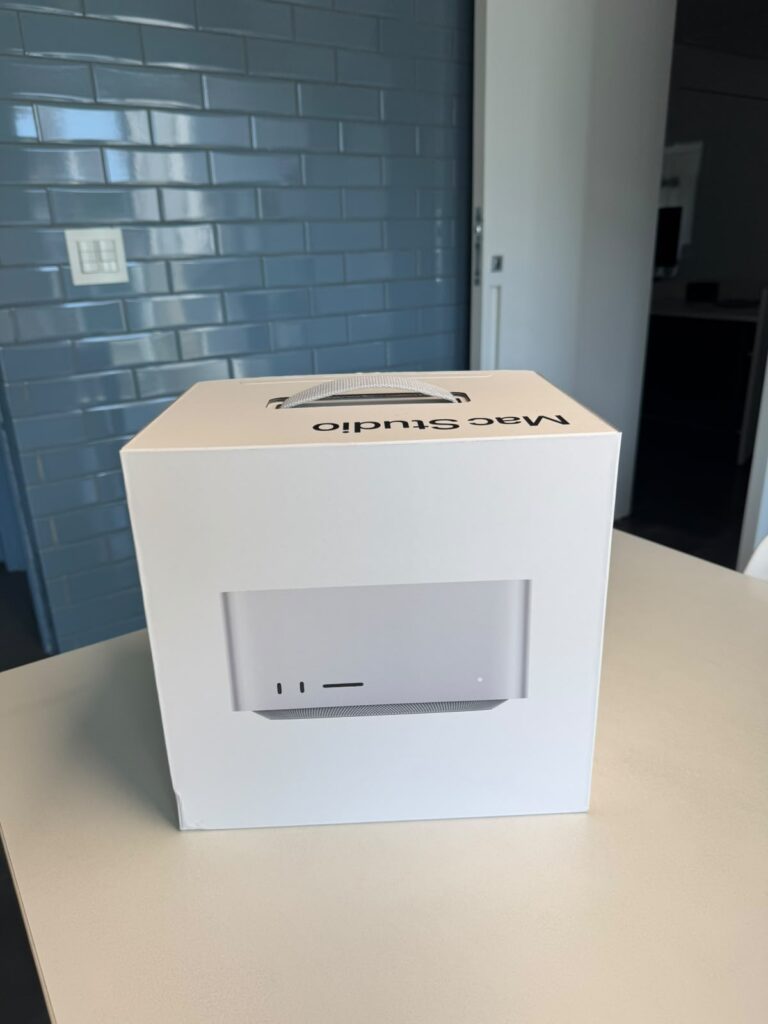
- Espresso bought a Mac Studio to run local AI and depend less on platforms from US companies.
- The machine has just arrived, so this text brings open questions, not results.
- Apple promises up to 512GB of unified memory and high AI performance, but the numbers come from the manufacturer itself.
- The cloud still makes sense: the point is knowing what depends on whom.
Cloud AI is convenient, but a lot of what it relies on isn't ours
Today, much of the artificial intelligence we use day to day runs on platforms owned by companies in the United States. It's convenient: we open an account and start using it. The price of that convenience is dependence. Pricing, usage rules and service availability sit in the hands of whoever operates the platform. This isn't a new discussion for us. When we wrote about what Anthropic's IPO shows us about the future of software development, the question we left was: how dependent are our processes on AI platforms? And when we wrote about software resilience, we saw that well-designed systems assume a supplier can fail. Buying the Mac Studio is our attempt to answer that question in practice, not just in writing.Why bring AI to our own desk
We want to explore the opposite path: running AI models at Espresso itself, on a machine of our own. The reasons are simple:- Autonomy. A model that runs here doesn't depend on an account, a plan or a third party's usage policy.
- Data closer to home. With the model running on the machine itself, the information doesn't need to leave it to be processed.
- Innovating in practice. We want to see up close what local AI can do, instead of just reading about it.
What the Mac Studio promises, and how we read each promise
Apple introduced the new Mac Studio lineup in August 2026 and positions it as a machine built for local AI. Here is what the manufacturer's announcement states and how we interpret each point.| Topic | What Apple says | How we read it |
|---|---|---|
| Memory | Up to 512GB of unified memory on the M5 Ultra version, and up to 128GB on the M5 Max | Memory defines the size of the model that fits on the machine. Each configuration has its own ceiling |
| Memory access speed | Up to 1.2TB/s on the M5 Ultra version | Capacity tells what fits. Memory access speed influences how fast the model responds |
| AI performance | Up to 4.3x the peak AI compute of the previous model with M3 Ultra | "Up to" and "peak" describe the best-case scenario, measured by Apple itself in July 2026. It isn't our day-to-day |
| Privacy and cost | Running large models on your own equipment, with complete privacy and without counting tokens | Makes sense in theory. Whether the cost pays off depends on usage, energy and software support, and that only shows up over time |
What we still don't know
The machine has just arrived. Before any result, what we have are questions, and we think it's more honest to start with them:- Do the models that fit on a local machine handle the tasks that really matter to us?
- How does the quality of the answers compare with the cloud models we use today?
- Is the speed in real use good enough for the team to want to use it every day?
- How much work does it take to keep all of this running?
- In the end, do the numbers add up when compared with using cloud platforms?
The cloud still makes sense in many cases
Bringing AI in-house doesn't mean abandoning cloud platforms. They remain the most practical option for plenty of things, and some tasks may demand more than a local machine delivers. The question that interests us isn't local versus cloud. It's knowing what depends on whom and choosing consciously where it makes sense to have more control.Innovating also means choosing where to have control
For us, the Mac Studio fits the way we look at AI: applied with judgment, and with the people using it in control. It's the same idea that guides our AI Solutions area. If you also think about platform dependency, local AI or where AI makes sense in your operation, let's talk. Reach us through the contact form or on WhatsApp.Frequently asked questions
What is local AI? It means running the artificial intelligence model on the company's own computer or server, instead of using a third-party cloud service. Questions and data are processed right there. The main gain is control. The cost is taking care of the machine and the software, and choosing models that fit the equipment. Why did Espresso buy a Mac Studio? To gain more autonomy and depend less on AI platforms from US companies. The idea is to run local AI and see up close what it can do. The machine arrived only recently and we have no results to share yet, which is why this text talks about questions, not conclusions. Does local AI replace cloud platforms? Not necessarily. Some tasks may demand more than a local machine delivers, and the cloud remains practical in many cases. For us, the question is which path makes more sense for each task, considering quality, cost and control over data. Can any AI model run on a Mac Studio? No. What decides it is memory: the model has to fit in it. Apple states up to 128GB of unified memory on the M5 Max version and up to 512GB on the M5 Ultra. Beyond capacity, speed, software and model precision also influence the result in real use. Manufacturer data from Apple's announcement of August 25, 2026. Performance numbers come from tests run by Apple itself in July 2026.Want to talk about AI with you in control?
If you also think about platform dependency or where AI makes sense in your operation, let us talk.