What Borussia Dortmund teaches us: UX goes beyond the screen
German football club Borussia Dortmund has launched a feature in its own app that rewards fans for not using their phones during the game. It sounds contradictory, but it is a useful reminder: in many products, the best experience happens off the screen, and time spent in the app says little about the value delivered.
Summary
- Borussia Dortmund’s “Fan Mode” gives points to fans who keep their phones locked during home matches.
- The club’s product is not the app, it is the afternoon at the stadium. The app was designed to serve that experience, not to compete with it.
- Screen time is easy to measure, but it can hide value as easily as frustration.
- What people remember is the moment, not the interface that made it possible.
Opinion piece by João Pedro Matumoto, product lead at Devint and, for many years, UX/UI designer at Espresso Labs.
An app that asks to be left in your pocket
In late October, Borussia Dortmund and Vodafone, a partner of the club, launched Fan Mode in the team’s official app. It debuted at the home game against Eintracht Frankfurt on October 24, according to the club’s official announcement.
The mechanics are simple. Fans turn on the mode, lock their phones and earn points for every minute the screen stays off. At half-time they can use the phone freely, but they need to turn the mode back on for the second half. To confirm they are actually at the stadium, the app asks for location access. Those with the most points can win signed shirts and vouchers for the official store.
The news traveled around the world and reached Brazil through Baguete on November 9, 2026. The most common reaction was amusement at the paradox: an app whose success is sitting idle. We think it is worth going beyond the curiosity, because the case touches on two questions every digital product should ask.
The club’s product is the stadium, not the app
The club justified the initiative with growing annoyance in the stands: selfies, live streams and social media competing with the game. The announcement cites a 2023 Vodafone survey of a thousand regular stadium-goers, in which 63% said they often use their phones during matches. The club’s CEO, Carsten Cramer, summed up the idea by saying that “this here and now is irreplaceable”.
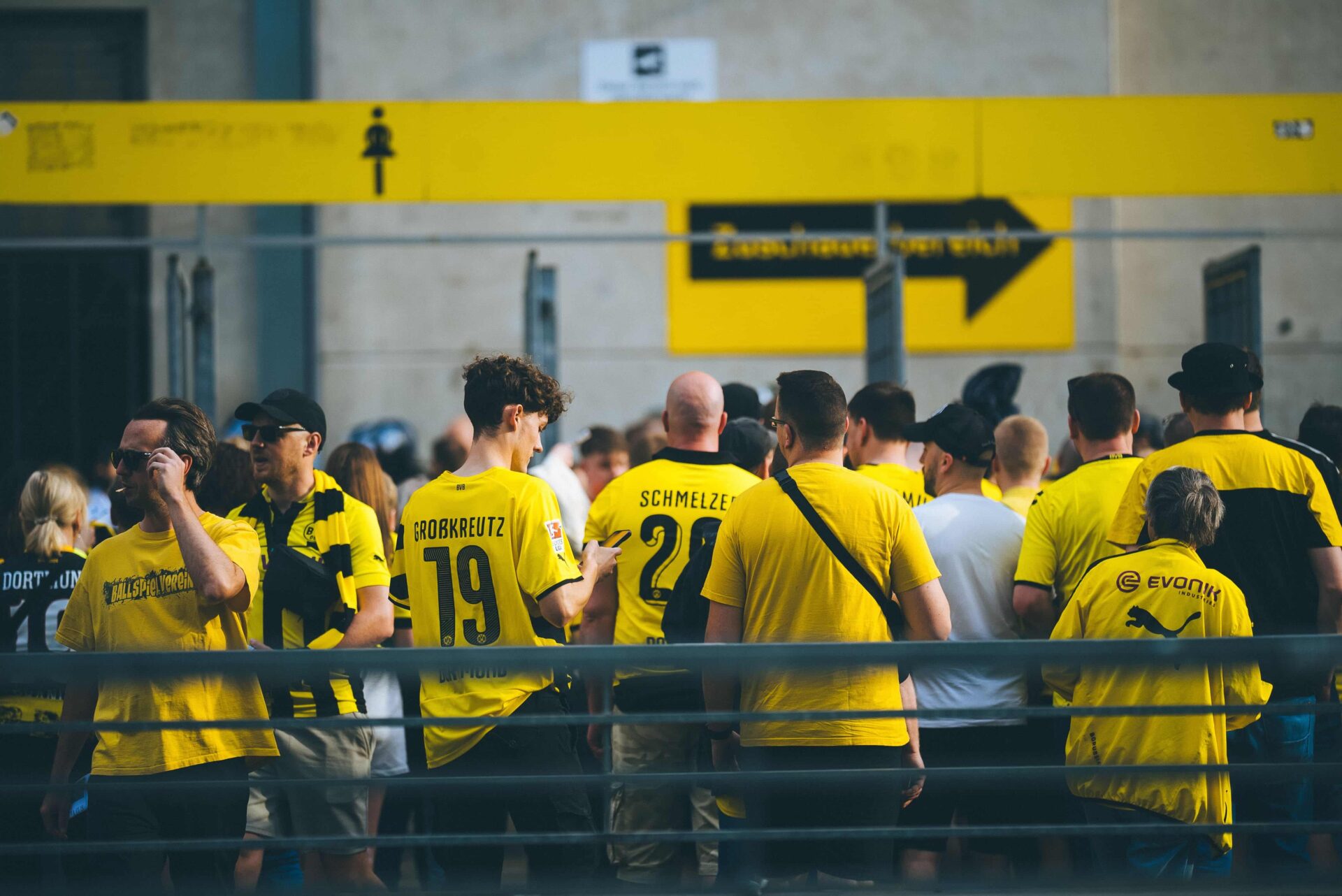
Notice what this decision reveals. Borussia Dortmund does not sell an app. It sells the experience of being with more than 80,000 people singing together. The app is just one piece of that experience, and the product team understood that, during the 90 minutes, its best contribution is to get out of the way.
This idea is not new. In 1995, Mark Weiser and John Seely Brown, researchers at Xerox PARC, coined the term calm technology to describe systems that inform without demanding the center of our attention. In the essay in which they developed the concept, they argued that what matters is not technology itself, but its relationship with people. Thirty years later, a football club put the principle into practice with a points counter.
The same goes for many products that accompany a physical experience: the airline app that exists for the trip, the hotel app that exists for the stay, the museum app that exists for the exhibition. When the app tries to become the center, it competes with its own reason to exist.
Screen time is an easy metric, and that is why it misleads
The second question is about measurement. Time in app, sessions per day and number of opens are tempting metrics because they come ready-made in any analytics tool. The problem is that they measure the attention the app consumed, not the value it delivered.
The market calls these vanity metrics: numbers that make us feel good but do not help us make better decisions. John Cutler, former product evangelist at Amplitude, explains in a well-known piece on the topic that their most common flaw is the lack of context. A spike in active users means something, but on its own it does not say what.
With screen time, the ambiguity is even greater. UXCam, an app analytics company, points out in its metrics guide that a long session can also belong to someone stuck on a confusing screen. The same number can tell a story of delight or of frustration.
In Borussia Dortmund’s case, the logic is inverted on purpose: the feature works better the less the phone is used. And the reward does not stay in the app. It takes the fan to the club store, in other words, to something that has value for the business. In our reading, it is a good example of a question that should come before any dashboard: what behavior, off the screen, does the product exist to encourage?
For a banking app, it might be settling a pending issue faster. For a health app, it might be a patient following a treatment. For an internal system, it might be the team finishing the day earlier. In none of these cases is “more minutes in the app” the right answer.
What stays in memory is the goal, not the interface
Nobody leaves the stadium telling friends that the club’s app is great. People talk about the goal, the song the crowd sang, the hug with the stranger next to them. When a product does its job well, the moment gets the credit.
We have already written on the blog about what makes a digital product experience memorable. One of the ideas our product managers and designers shared in that piece is invisible complexity: a product can be complex inside, as long as the people using it barely notice. Fan Mode takes this reasoning to the limit. During the game, the best interface is a dark screen.
This does not mean the app has lost importance. Before and after the match, it remains useful as a matchday guide and for following the club. The difference is that it knows when to show up and when to disappear. Designing the experience also means designing the absences.
Disconnecting also has a cost
It would be easy to turn the case into unqualified praise, but it has points worth debating.
- Privacy: to work, the app asks for the fan’s location and tracks when the phone is unlocked. Even though it is voluntary, it is a volume of data that calls for transparency about what is stored and for how long.
- Gamifying disconnection: a points leaderboard can create another kind of anxiety, the urge to check your score. The line between encouraging a habit and creating a new dependency is thin.
- People who film are not necessarily the problem: many fans record the game to keep a memory. Rewarding abstinence may feel like a judgment to them.
Other German clubs chose different paths. Dynamo Dresden and Hertha Berlin, from the second division, banned commercial videos by influencers in their stadiums this season, while still allowing personal photos and videos, as reported by Flashscore. It is a response to another problem, the monetization of the crowd, through rules. Borussia Dortmund preferred incentives. Neither path is the definitive answer, and it is precisely this variety of attempts that makes the topic interesting.
What we take from this into the products we design
For us, the Borussia Dortmund case is less about football and more about a question that applies to any digital product: where does the experience really happen? Sometimes it is on the screen. Often it is off it, and the app only prepares, accompanies or records that moment.
Three ideas the case reinforces:
- Start with the moment, not the screen. Before thinking about flows and features, it is worth understanding the situation people are in when they use the product and what they want to experience there.
- Choose metrics that tell the user’s story, not just the app’s. Time in app can be on the dashboard, but alongside something that shows whether the person’s goal was achieved.
- Accept that success can be a closed app. A product that solves things quickly and gives people back to their lives tends to be remembered more fondly than one that demands attention all the time.
Cramer says technological progress should not be avoided. We agree, with one adjustment: progress is technology that improves the experience, even when that means stepping offstage. If this topic is on your desk too, we would love to talk about it.
Frequently asked questions
What are vanity metrics?
They are indicators that look positive but do not help with decisions, such as downloads, page views or total time in app analyzed without context. They can go up without the product delivering more value. Ideally, combine them with indicators tied to the user’s goal, such as completed tasks or retention over time.
Is screen time a bad metric for measuring user experience in apps?
Not necessarily, but it is incomplete. In entertainment apps, more time can signal interest. In service apps, it can signal difficulty completing a task. That is why screen time needs to be read alongside other signals, such as task completion, spontaneous return and stated satisfaction.
What is calm technology?
It is a concept created in 1995 by Mark Weiser and John Seely Brown, researchers at Xerox PARC. It describes technologies that inform without demanding the center of our attention, staying in the periphery until they are needed. In 2015, researcher Amber Case revisited the topic and organized practical principles for designing less intrusive products.
About the author
João Pedro Matumoto is a designer from São Paulo with nearly ten years of experience in digital design, UX/UI and strategy. Throughout his career, he has led design and development teams, managed projects, built processes and shaped digital product strategy. He holds a postgraduate degree in Strategic Design Management from FAAP. For many years a UX/UI designer at Espresso Labs, he now leads Devint, the company’s performance evaluation platform for technology teams.
Where does your product experience happen?
Tell us what you are building and let’s talk about how to design the experience beyond the screen.